ACTOR HOFFMAN'S FATAL HEROIN OVERDOSE PUTS FOCUS ON DEALERS

Saturday, 8 February 2014

crimesider

ACTOR HOFFMAN'S FATAL HEROIN OVERDOSE PUTS FOCUS ON DEALERS

A photo of actor Philip Seymour Hoffman, as part of a makeshift memorial in front of his apartment building in New York.  REUTERS
NEW YORK - Most of the nearly 40,000 Americans who die each year from a drug overdose do not make the front page, but when revered actor Philip Seymour Hoffman was found dead Sunday with a needle in his arm, the nation took notice.
And so did the police. On Tuesday, four people were arrested on drug charges and are reportedly being questioned in relation to Hoffman’s death, placing the actor’s untimely demise squarely in the middle of a new trend in the war on drugs: charging dealers when their customers die.
“We’re coming for you,” says Al Della Fave, spokesman for the Ocean County, N.J. prosecutor’s office.
Fave told CBS News’ Crimesider that since he came into office in April 2013, prosecutor Joseph D. Coronato has “been on a mission” to hold dealers accountable for the deadly effects their products are having on citizens of Ocean County. According to Fave, of the 53 Ocean County residents who died of overdose in 2012, the majority were using heroin. Total overdoses in the county more than doubled in 2013, to 113; and so far in 2014, Fave says there have been eight fatal overdoses, seven involving heroin.  
On Jan. 10, Coronato's office secured a 11-and-a-half year sentence for Kenneth Staunton, a 33-year-old who pleaded guilty to heroin possession and manslaughter in relation to the death of a 27-year-old man who overdosed on Stauton's product.
And just last week in Illinois, a 27-year-old woman was sentenced to four years in prison after she reportedly pleaded no contest to first degree reckless homicide for selling heroin to a man who died from overdose. 
Kerry Harvey, the U.S. Attorney for the Eastern District of Kentucky, is also cracking down on dealers in his state.
“We have had a truly horrific problem with prescription drug abuse,” Harvey told Crimesider. And while he says they’ve been able to restrict the supply of these drugs somewhat, the crackdown has “caused a comeback of heroin.”
Instead of specifically charging dealers with their customers’ overdose deaths, Harvey says his office has used sentencing enhancements that allow for as many as 20 years in prison if a death results from an illegal narcotic distributed by the suspect.
“It’s hard to deter someone acting out of an addiction, but you can deter people who are acting out of greed,” says Harvey. “We want them to know they’re risking their own life [when they deal], at least in terms of their freedom.”
Part of this new push has been to train first responders like police and EMTs to treat overdose scenes not as accidents, but as potential crime scenes. They’re taught to secure the scene, interview witnesses, and collect evidence, like pill bottles, needles and the all-important cell phone. Harvey pointed to one recent case where an overdose victim had called his dealer just hours before his death.
In addition, Harvey said that he’s conducted training at local coroner and medical examiner’s offices to make sure that overdose victims are autopsied so that a connection can be established between the death and the drugs.
“We’re trying to change the cost-benefit analysis for dealers,” says Harvey. “With every heroin transaction there is a significant risk of overdose death. We want them to know if their customer ODs, they will be held responsible.”

A Tribute to Paul Walker

Monday, 9 December 2013

A Tribute to Nelson Mandela - Tata

Freedom fighter, prisoner, moral compass and South Africa's symbol of the struggle against racial oppression.
That was Nelson Mandela, who emerged from prison after 27 years to lead his country out of decades of apartheid.
He died Thursday night at age 95.


His message of reconciliation, not vengeance, inspired the world after he negotiated a peaceful end to segregation and urged forgiveness for the white government that imprisoned him.
"As I walked out the door toward the gate that would lead to my freedom, I knew if I didn't leave my bitterness and hatred behind, I'd still be in prison," Mandela said after he was freed in 1990.
Mandela, a former president, battled health issues in recent years, including a recurring lung infection that led to numerous hospitalizations.
Despite rare public appearances, he held a special place in the consciousness of the nation and the world.
"Our nation has lost its greatest son. Our people have lost a father," South African President Jacob Zuma said. "What made Nelson Mandela great was precisely what made him human. We saw in him what we seek in ourselves."
His U.S. counterpart, Barack Obama, echoed the same sentiment.
"We've lost one of the most influential, courageous and profoundly good human beings that any of us will share time with on this Earth," Obama said. "He no longer belongs to us -- he belongs to the ages."
A hero to blacks and whites
Mandela became the nation's conscience as it healed from the scars of apartheid.

His defiance of white minority rule and long incarceration for fighting against segregation focused the world's attention on apartheid, the legalized racial segregation enforced by the South African government until 1994.
In his lifetime, he was a man of complexities. He went from a militant freedom fighter, to a prisoner, to a unifying figure, to an elder statesman.
Years after his 1999 retirement from the presidency, Mandela was considered the ideal head of state. He became a yardstick for African leaders, who consistently fell short when measured against him.
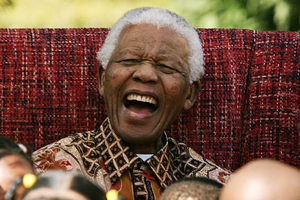
Warm, lanky and charismatic in his silk, earth-toned dashikis, he was quick to admit to his shortcomings, endearing him further in a culture in which leaders rarely do.
His steely gaze disarmed opponents. So did his flashy smile.
Former South African President F.W. de Klerk, who was awarded the Nobel Peace Prize with Mandela in 1993 for transitioning the nation from a system of racial segregation, described their first meeting.
"I had read, of course, everything I could read about him beforehand. I was well-briefed," he said.
"I was impressed, however, by how tall he was. By the ramrod straightness of his stature, and realized that this is a very special man. He had an aura around him. He's truly a very dignified and a very admirable person."
For many South Africans, he was simply Madiba, his traditional clan name. Others affectionately called him Tata, the word for father in his Xhosa tribe.
A nation on edge
Mandela last appeared in public during the 2010 World Cup hosted by South Africa. His absences from the limelight and frequent hospitalizations left the nation on edge, prompting Zuma to reassure citizens every time he fell sick.
"Mandela is woven into the fabric of the country and the world," said Ayo Johnson, director of Viewpoint Africa, which sells content about the continent to media outlets.
When he was around, South Africans had faith that their leaders would live up to the nation's ideals, according to Johnson.
"He was a father figure, elder statesman and global ambassador," Johnson said. "He was the guarantee, almost like an insurance policy, that South Africa's young democracy and its leaders will pursue the nation's best interests."
There are telling nuggets of Mandela's character in the many autobiographies about him.
An unmovable stubbornness. A quick, easy smile. An even quicker frown when accosted with a discussion he wanted no part of.

Funerals V Memorial Service

Thursday, 7 November 2013

 Increasingly, the two terms are used interchangeably, especially with cremation growing in popularity making it easier to move the remains of the deceased. 


Traditionally, funerals take place with the body or the ashes of the deceased person present. Memorial services have been ceremonies without the presence of the body although an urn containing the ashes may be present. 

Funerals are usually held immediately following death whereas memorial services may take place weeks or months away. In the past, memorial services also have been less formal than funerals with greater participation by family and friends. 

This is changing, however, as funerals are becoming less centered on the leadership of one person. Memorial services do not necessarily take place in a funeral home or religious setting. 

They may be held in the home or other comfortable gathering place. Funerals are most often held in traditional settings (cemetery, chapel or church) and are often followed by a graveside service. In the future, “funerals” and “memorial” services will both be used to describe the service of celebrating death.

Mandela now being treated at home

Sunday, 8 September 2013

Former President Nelson Mandela has spent his first night back at his Houghton home after being discharged from hospital on Sunday.
The Presidency confirmed on Sunday morning that Madiba was finally going home after spending nearly three months at the Mediclinic Heart Hospital in Pretoria for a recurring lung infection.
A statement issued by the Presidency followed media speculation on Saturday that the former President was going home.
The presidency said the statesman will continue receiving treatment at his Houghton home.
But despite being discharged, the presidency said Madiba’s condition still remains serious and unstable at times and the possibility that he may be readmitted hasn't been ruled out.
The 95-year-old former president's home has been furnished with all the medical equipment needed to treat him.
The presidency also called on members of the public to allow Mandela and his family the necessary private space so that his continuing care can proceed with dignity and without unnecessary intrusion.


Well wishes
Mandela's eldest grandson Mandla said he's delighted his grandfather is back home.
Mandla said his grandfather's return home proves that claims by other family members that Madiba is in a vegetative state aren't true.
At the same time, the Nelson Mandela Centre of Memory says it is pleased that the statesman has been discharged from hospital and is home with his family.
The centre's Sello Hatang also encouraged the nation to continue Madiba's legacy.
"We should all be praying for Madiba until he fully recovers, but also continue to do our bit to bring change to our communities not just on Mandela Day, but everyday."
Political parties such as the ANC and United Democratic Movement (UDM) have extended well wishes for Madiba and also thanked the South African public for their continued support.
The ANC's Khusela Sangoni-Khawe said, "The ANC is grateful for the support that South Africans and the whole world have given Madiba and his family. We wish him all the best and hope he'll fully recover soon."
UDM Leader Bantu Holomisa welcomed the global icon's recovery.
Holomisa said the UDM wishes the former President a speedy recovery.
"The UDM along with the Mandela family, South Africans and the rest of the world in welcoming Madiba back home and we wish him well."

Quotes about Life and Death

Tuesday, 6 August 2013

God pours life into death and death into life without a drop being spilled.  ~Author Unknown


All say, "How hard it is that we have to die" - a strange complaint to come from the mouths of people who have had to live.  ~Mark Twain


I'm not afraid of death.  It's the stake one puts up in order to play the game of life.  ~Jean Giraudoux, Amphitryon, 1929


All our knowledge merely helps us to die a more painful death than animals that know nothing.  ~Maurice Maeterlinck


To himself everyone is immortal; he may know that he is going to die, but he can never know that he is dead.  ~Samuel Butler


Watching a peaceful death of a human being reminds us of a falling star; one of a million lights in a vast sky that flares up for a brief moment only to disappear into the endless night forever.  ~Elisabeth Kübler-Ross


Gaily I lived as ease and nature taught,
And spent my little life without a thought,
And am amazed that Death, that tyrant grim,
Should think of me, who never thought of him.
~RenƩ Francois Regnier


The fear of death follows from the fear of life.  A man who lives fully is prepared to die at any time.  ~Mark Twain


We cannot banish dangers, but we can banish fears.  We must not demean life by standing in awe of death.  ~David Sarnoff


Men fear Death, as children fear to go in the dark; and as that natural fear in children is increased with tales, so is the other.  ~Francis Bacon, Essays


If you spend all your time worrying about dying, living isn't going to be much fun.  ~From the television show Roseanne


Some people are so afraid to die that they never begin to live.  ~Henry Van Dyke

Nelson Mandela still in critical condition

Sunday, 7 July 2013

Members of Nelson Mandela's family have met tribal leaders in his home village to discuss his seriously ill health. The former South African leader remains in a critical condition in hospital in Pretoria after he took a turn for the worse over the weekend, the country's President Jacob Zuma said in his latest statement. Mr Zuma said: "We must support him and support his family. "We must demonstrate our love and appreciation for his leadership during the struggle for liberation and in our first few years of freedom and democracy by living out his legacy and promoting unity, non-racialism, non-sexism and prosperity in our country."


 Sky's Alex Crawford said elders in the village of Qunu had been briefed on Mr Mandela's condition, and that they had been told he was no longer breathing on his own. His family described the 94-year-old's condition as "at its worst", Crawford said. The anti-apartheid leader has been in intensive care since he was last admitted to hospital on June 8 for a recurring lung infection. His wife, Graca Machel, has been by her husband's bedside since he was taken ill.

 Tough Times Funeral Transport

Followers

Labels

Dolor